Tuesday, February 14, 2017

What's Next For Tiger?

it's been a while but Tiger is back on the radar in his never ending quest to re-establish himself as a force on the PGA Tour. This latest attempt to return has yielded a miss cut at the Farmers (76-72) and a WD (due to back spasms) at Dubai (77) which leaves the golfing world with still more questions than answers.

With a respectable showing in December at the Hero (-4) it appeared that this time around might be the charm. In talking with people in the industry as well as fans alike, it seems there are two schools of thought. Some believe Tiger is done and just hasn't accepted it yet while others believe this latest set back is an unfortunate delay on his path at making one last run. Whatever your thoughts are, the fact that TW's has not been competitive in quite some time does make you wonder how someone of such caliber drops so far so fast.

There is no lack of opinions when bringing up the fall of Tiger and certainly we'll never know for sure, but we do know he's not the first great golfer to travel this path and he won't be the last.

As a golf professional I have spent many hours studying, analyzing, and breaking down most of the golf swings you see when watching golf on Saturday's and Sunday's. Although I don't know Tiger personally, I do know golfers, golf swings, learning styles and the psyche of golfers in general, yet my take on the situation is not a technical one at all, rather the opposite. Anyone who has given this issues more than 5 minutes of thought could easily come to the same conclusions.

Tiger had such a free flowing swing throughout college and well into his professional career. At times it appeared he was on auto pilot winning tournaments by big margins. By most observers accounts it was a matter of time before he would break Jack;s records and all other other record in golf that mattered.

Now let's travel back in time a bit. TW played some of his best professional golf under Butch Harmon yet there came a point in time when Tiger felt he needed something more. Enter Hank Haney another world class instructor and again Tiger's success again was pretty substantial and yet again the need for something more arose. Enter Sean Foley (with a bio mechanics focus approach) and the success dropped off noticeably. The need to change directions again came in the form of Chris Como, his latest swing coach. Throw in there the wife incident and the death of his driving force (his father) and well, here we are.

From a swing stand point I believe the bio mechanics focus (which still seems to be part of his current coaches philosophy) in my opinion, doesn't blend well with TW's over analytical personality. As a coach I tend to believe Tiger  would be better served by a "thinking less not more" approach. Swinging freely like earlier in his career rather than being bogged down with thoughts of what each muscle does at any particular point in his swing. Most noticeably his current swing has him coming more up and out of his posture upon impact which is opposite of what he's done throughout most of his career. The reason for this is to take pressure off his back which seems reasonable. However, there are others ways to achieve that same goal which I believe would be more in line with what his muscle memory is already conditioned to do, but we'll save that for another article.

So what's next? That's the sixty four thousand dollar question. His current regiment, whatever that may consist of, isn't cutting it and if he stays this current course, then I believe his competitive days are numbered.

On the other hand, a fresh new direction with a focus on simpler and less strenuous movements could be just what the doctor ordered and a return could indeed be a reality. But if Tiger keeps trying to put square pegs in round holes, well....we all know how that usually works out.


Blog written by Vince Fratercangelo-Director of Instruction at VJF Golf Academy


Wednesday, September 28, 2016

Alignment: The Most Important Piece of the Consistency Puzzle

When a student comes to me for the first time, there are a variety of probing questions I like to ask as it kind of provides a road map of where the lesson may be going. One of the most important questions that I feel all instructors need to know before starting a lesson with a new student is "what's your goal." Inevitably the answer I get to this question 90% of the time is "consistency."

Certainly a goal that all golfers need if one is to achieve any level of sustainable success. However, the most important building block in reaching that goal is a building block that a majority of golfers ignore or at the very least, don't consider it a skill that needs regular practice. Unfortunately for so many that signals the beginning of the end.

In a quest to improve, golfers flock to all forms of media in search of the eternal answer on how to improve. In my opinion every article, video and tip related to golf swing improvement should start with mention of alignment. Unfortunately, that's not the case. Can you find articles on proper alignment? Of course, but you have to do some moderate digging. My experience tells me the reason for this is that pointing yourself in the right direction is a given, it's the mechanics that need to be mastered.

No doubt, mastering mechanics is necessary, but how can that be achieved if one never aligns themselves the same way twice? In short it can't, and there in lies the problem. A golfer can not progress the improvement of their swing without mastering the art (and skill) of alignment. Does it mater what your lead arm is doing throughout the swing? If your weight is transferring correctly? Hands releasing? No, no and no unless you are aligned correctly each and every time you stand over the ball.

The solution is simple really, practice alignment 100% of your practice time. Change your targets often throughout your entire practice session. Use alignment sticks or clubs on the ground to insure you are aligned correctly. Otherwise the percentage is high that you'll start to develop bad habits that we all know are hard to break.

Once you have committed to practicing alignment, one then must understand how the alignment set up works......

Friday, July 15, 2016

Creating Muscle Memory For Better or Worse


We've all heard the phrase "practice makes perfect" and many golfer who do actually practice regularly have no doubt taken that mantra literally. But for those of us who have been around the game for umpteen years, see it a bit differently. Especially those of us who reside in the world of player development.

A golfer can practice 3 times a week for 2 hours at a time over a 5 year period, certainly such a devoted range rover should be well on his/her way to great golf and a perfect swing. Unfortunately such a golfer logging such hours could actually be doing more harm than good. Why you ask?
Because it's not just about how often you practice, it about what you practice. Too many golfers put in time that is not well spent which leads to maddening frustration.

To get the most out of your practice sessions and to make your hard work pay off, golfers need to make sure that they are practicing the right things. But how does one know for sure? Great question! First and foremost the golfer has to have a clear idea of what he/she is trying to accomplish. Second, the understanding of ball flight laws and cause and effect as it relates to the golf swing. This allows a golfer to make proper assessments and adjustments during practice rather that just hitting balls blindly hoping things work themselves out. And finally, and I'm a bit bias towards this last point for obvious reasons, the assurance of a trained and experienced eye to make sure things aren't getting off track. Too many times golfers tend to get away from the things they've learned and fall back into bad habits without even knowing it's happening, and before you know it you're on your way back to square one. I certainly don't think a golfer needs to take a lesson one a week for life to make sure he/she never picks up additional bad habits. However, I do believe taking a lesson once a month so that things don't stray to far off the path is a reasonable idea.

So, if you're putting in the time but feel you are going nowhere, it might be time to see your local professional, get a clear game plan on what is needed to improve and then devise a plan as to how to maintain your hard work. With all the pieces in place, permanent improvement is achievable.


Blog written by Vince Fratercangelo-Director of Instruction at VJF Golf Academy

Friday, April 8, 2016

How To Beat The Yips - Special Masters Edition


The "Yips" to many golfers are somewhat of a mystery in that a majority of golfers aren't quite sure exactly what the origin stems from; part psychological or part technical or maybe a hybrid of both perhaps. As someone who has helped numerous golfers overcome this problem I can tell you, from my perspective, its a combination of both. Well, kind of anyway, let me explain.

The infancy of the issue starts as a psychological barrier which in turn infiltrates one's technical capabilities thus making the simplest of functions seem extraordinarily difficult i.e. a 3 foot putt. So how does one overcome such an issue to regain control over what should be routine functions? Well, that is the million dollar question and I can tell you that different professionals have different philosophical ideas on how to tackle the problem.

For me, when working with players, I approach it through a alteration of feel. First, regardless of the grip style you are using I have my students grip their putter with 80-85% grip pressure in their non dominant hand and 15-20% grip pressure in their dominant hand. Second I have my students (using the grip pressures mentioned) hit 3 and 4 foot putts with the putter head cover on.


The reasons for the lopsided grip pressure distribution is due to the fact that in highly accomplished players especially, the "yips" tend to effect the dominant hand. So the less grip pressure applied to the putter with the dominant hand, the less chance it has to wreak havoc on the putting motion.

As for the head cover on the putter, this is to change the sensation (feel) of impact. It's a form of tricking your senses. The combination of different grip pressures coupled with the sensation of the golf ball being stroked with a softer feel (head cover on putter) gives the mind a different set of circumstances to deal with, this changes the focus of the mind.

Once this is conducted for a period of time, remove the head cover and continue applying the  two different grip pressures mentioned above. Start with 2 footers working up to about 5 feet. Anything longer than 5 feet I suggest balancing out the grip pressure more evenly. However on shorter putts (5 feet or less) I highly recommend implementing the duel grip pressure method to all golfers regardless of whether or not the golfer is dealing with the yips. This will help to  decrease the chances of the dominant hand dominating the putting motion.


Blog written by Vince Fratercangelo-Director of Instruction at VJF Golf Academy


Monday, March 7, 2016

Focus On The Flat Stick To Lower Your Scores


As golfers we know that there is no "finish line" in golf but rather a quest to improve regardless of one's ability level. When you break 100 you strive to one day break 90 and then 80 and so on. Tour players are always striving to improve, it's the DNA of most golfers to want to "play better" each time we hit the links.

 With 40% of all shots being putts, it's clear where golfers should be spending a majority of their practice time. This is something I stress to my students all the time; If you want to get better, become a better putter. And the good news is that putting can be practiced all year round either indoors or out.
So now that you're committed to devoting more time to the flat stick, there are two areas of concentration I emphasize to my students, grip and length of stroke. Step one is to find a grip that will help eliminate excess wrist break and promote a pendulum motion. Seen in the picture above are a sampling of grip styles you can use and there are certainly a number of others. Remember effectiveness before beauty.

Once a grip style is decided, focus on length of back swing and thru swing as this will help develop solid distance control. Whether you have a 30 foot putt or a 3 foot putt your stroke should be a mirror image on both sides of the ball (see picture).
Focusing on these two elements of putting will have you shooting lower scores and helping you achieve that next goal.

 Blog written by Vince Fratercangelo-Director of Instruction at VJF Golf Academy

Monday, February 29, 2016

Good Decisions Lead To Lower Scores

In working with golfers of all ability levels, good swing mechanics are the key to playing better golf. After all, it is good swing mechanics that lead to a repetitive swing motion which in turn leads to consistency. However, there are two sides to every coin. In addition to solid swing mechanics you also need solid course management.

The lack of strategic thinking on the golf course can derail a round of golf every bit as fast as a few wayward swings. Golfers who consistently play at a high level understand that every decision they make in a round of golf can mean the difference between an average round and a great round! Whether its where you're teeing it up in the tee box (which is determined by your ball flight) or what pins you should go for on approach shots and on par 3's. These types of decisions will ultimately play a big role in that final number on your scorecard.


So next time you hit the links remember you don't need to reach every par 5 in two, make every 20 foot putt, stick it tight next to every pin or hit a driver on every par 4 and 5. Like in so many other sports, a player that has an upper hand in intelligence will outperform a player that has the upper hand in physical ability most of the time. Keep it in the short grass!


 Blog written by Vince Fratercangelo-Director of Instruction at VJF Golf Academy


Monday, February 22, 2016

Maintaining Posture = Better Contact!


After hitting a thin or topped shot, have you ever told yourself "I picked my head up?" Too often that diagnosis is only partially true and not usually the root cause of the poor shot.
It is true that the head does come up prematurely but more times than not it is because the golfer comes out of their posture much too early. And because the head is connected to the spine, it comes up as well.

You can keep your head down all day long but if you start to come out of your posture around impact (which is common among amateur golfers) the result will be a thin shot most of the time
As you can see in the above picture, the golfer's spine isn't even perpendicular to the ground in his finish as he never fully comes out of his posture which is one of the big differences between amateurs and professionals.

So if you are prone to hitting thin / topped shots, focus on staying in your posture longer and soon you'll be hitting more solid shot and gaining more distance.


 Blog written by Vince Fratercangelo-Director of Instruction at VJF Golf Academy

Monday, February 8, 2016

Improve Your Distance Control & Eliminate 3 Putts!

Nothing adds to a less than stellar round of golf like a bag full of three putts. For many golfers, the lack of putting prowess can be attributed to lack of practicing with the flat stick. The driver get all the (practice) attention, yet its the 3 putts than haunt your dreams.

For those that don't practice putting enough, I suggest you turn your practice sessions into a productive challenge against yourself with my "Safe Zone" drill.. This serves two purposes; 1. It makes practicing more fun and 2. Its been proven that competitive practicing can enhance your practice sessions. Think of it as  practice amped up on your favorite energy drink.

This particular practice drill can be a challenge against yourself or even against another golfer. Either way it will boost you practice productivity x 5 and have you on your way to eliminating the dreaded 3 putts. Soon you'll go from being the boss of the "toss" (as in throwing your putter) to being the boss of the moss.

Start implementing the Safe Zone drill and you'll soon be putting "Like A Boss" ! 


 Blog written by Vince Fratercangelo-Director of Instruction at VJF Golf Academy

Monday, February 1, 2016

Mastering The Dreaded Buried Bunker Shot aka Fried Egg!


Are you a golfer that cringes when you hit a wayward shot that ultimately comes to rest in the bunker? Worse yet, as you approach your ball you can only see the top half of it. Now the thoughts of a snowman (that's an 8 on the scorecard for the newbies reading this) gets your blood boiling and you haven't even pulled your wedge out of your bag yet.

In reality the sand is not such a bad place to be and getting out, when all is said and done, can really be a routine occurrence. Most golfers that are proficient from the beach (beach is another name for bunker for the newbies) consider a sand shot, either buried or not to be a fairly easy shot to execute. The biggest difference between the two is a buried shot comes out with more top spin while a shot off the surface of the sand allows a golfer to create some back spin. Other than that both shots should be equally easy to extract if you are using proper technique.

What really makes being in the bunker difficult is that most golfers don't practice this shot and the only time they experience it is during a round. So the lack of being able to create good muscle memory to rely on makes this shot more stressful that it has to be. Like any shot in golf the more you practice it (correctly of course) the easier it becomes.

Next time your in the bunker try using the mentioned technique and remember; a bunker shot is a lamb dressed like a wolf, it may look intimidating but we know the real truth.


 Blog written by Vince Fratercangelo-Director of Instruction at VJF Golf Academy

Monday, January 18, 2016

Generating Power: Bottom Up Not Top Down

One of the most common problems I see with students on a regular basis is the use of the upper body initiating the downswing. This is a common problem that is due in part to the fact that most golfers feel stronger and more powerful from the waits up rather than from the waist down.

The problem with this is more times than not when you start your downswing with the upper body, you end up with an outside in swing and we all know what that usually produces.....the dreaded slice! Timing is a key element of developing power and consistency and to get the most out of your swing we need to build a downswing that starts at ground level, literally.


Just like building a house, you don't start with the roof, you start with a solid foundation and your golf swing should as well. When your club hits the pinnacle of its backswing and its ready to start moving back to the ball, the first motion to trigger that downswing should be the lower body. From the feet to the legs, then hips, trunk (your midsection), and so on.

If you are a slicer or have other inconsistencies in your swing it may very well be how you are initiating your motion back to the ball.

For more information on how to to utilize the lower body properly visit me on YouTube The Downswing.


 Blog written by Vince Fratercangelo-Director of Instruction at VJF Golf Academy
 

Monday, January 11, 2016

Get It Up & Down From Green Side Rough

Most golfers know  that chipping (and putting) are parts of the game that can save you a ton of strokes or cost you a ton of strokes. Being efficient at getting up & down requires a lot of practice and the closer you are to the hole the more finesse is required to be successful. The nature of chipping means you have to develop an acquired "feel" and smoothness to the shot which can only be accomplished through doing and doing and.....you get the idea.

Now lets raise the stakes a bit! You miss the green and are sitting in green side rough, the difficulty of this shot has now been raised a few notches, depending on the thickness of the rough and how much your ball is sitting down in it requires extra precision just to get iit on the putting surface.

Enter the "Chop & Roll." I have been using and teaching this technique for many years and I can tell you that it is almost fool proof for getting on the green and giving yourself a shot at a putt. With some practice you can actually get rather accurate with this method but like anything it requires putting in the time. If done correctly it is a very high reward low risk shot.

Below is an illustration on how to perform this shot:


So next time you're in green side rough give it a try, you'll soon start saving strokes in places that use to cost you strokes!

 Blog written by Vince Fratercangelo-Director of Instruction at VJF Golf Academy

Saturday, December 12, 2015

Stroke Savers

It is no secret that there are numerous ways to get your "golf improvement fix" these days from the golf channel to YouTube and from golf blogs to golf magazines it can no doubt be overwhelming. In many cases the information is even conflicting and that's not always a bad thing. People learn in a variety of different ways and through a variety of different methods and the approach to helping golfers improve should vary. What works for one may not work for another and so it's important for golfers seeking help to do a bit of research to see who teaches what and what methodologies best fit with their way you learning.

Like I always tell my students find one source and stick with it, too many cooks in the kitchen spoils the food. There are too many different ways to swing a golf club and trying to incorporate various theories into one or worse yet jumping from one to another to another because the prescription from one source to fix the problem didn't take hold within the first few days of the process. Golf is a game that just can't move at break neck speed like so many things in the world today, improving your game is a process that can't be rushed much like a fine aged wine, the final product will be worth the wait............. if you can stick it out.

My approach to helping golfers has always been a simplistic approach. Keep it simple and not get over technical, identify one or two core issues and hammer them out. Let's face it, most weekend warriors don't have the time to do much more than that anyway so why waste time overloading.

Below is a compilation of quick tips that I have put together which you will also find posted regularly on twitter. Take a look and maybe you'll find a solution or two that works for you. Yes, we are adding to the numerous volume of golf overload these days, however our goal is to inform and let you decide if it's a good fit for you.


To learn more about my methods, techniques, and style of teaching and to find out if it might be right for you visit us in a variety of places:


Blog written by Vince Fratercangelo-Director of Instruction at VJF Golf Academy


Monday, December 7, 2015

Indoor Practice Series – Keep Your Stroke On Line


What you need:
  • ·         Putter
  • ·         One other club or yard stick or broom etc.
Lay a club on the ground as seen in the picture and set up your putter on the shaft of the club, then make your stroke. Immediately you will be able to tell if your stroke gets off line. Spend a few minutes each day working on maintaining a stroke that stays on the club you’ve laid down.

It won’t be long and you’ll soon start making more putts!


Note :::: There are 2 basic types of putting strokes, the “Straight back/Straight Through” stroke & the “Arc” stroke. Both can be effective but getting the most out of your stroke will usually depend on your posture. The drill mentioned here is for golfers who subscribe to a straight back/straight through philosophy. If you’re standing too upright and trying to putt straight back/through or if your posture is more tilted and you’re trying to use the arc method you may want to re-adjust your posture to be more conducive to the style you’re trying to use. It could be the difference in making more putts! Good Luck!


Blog written by Vince Fratercangelo-Director of Instruction at VJF Golf Academy
Thursday, December 3, 2015

Indoor Practice Series - 4 Cup Putting Drill


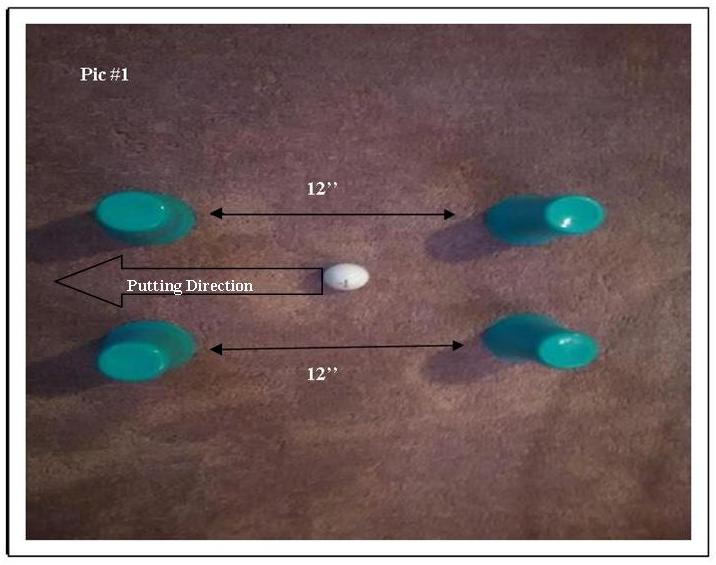
Set up 4 cups about 12’’ apart as seen in pic #1. Then, make sure your putter  has  just enough room to clear the cups (as seen in pic #2, about  ¼” off the toe & heal of putter).

What you need:

  • Putter
  • 4 cups
  • Golf Ball


Now work on your stroke trying not to touch the cups. If your putter happens to bump or hit one of the cups your stroke is not staying on line. Also, take note (even possibly keeping a journal) of how many times you hit a cup and which ones you hit. This is important because it will show a reoccurring pattern in your putting motion. By keeping mental notes or a journal of what cups you’re hitting most often, you’ll better be able to make adjustments in your practice. Happy Putting !


 Blog written by Vince Fratercangelo-Director of Instruction at VJF Golf Academy